Edward Steichen

"I am a Luxembourgish boy." Edward Steichen, introducing himself to Grand Duchess Charlotte at the White House, Washington, 1963.
A Luxembourgish boy
Édouard Jean Steichen was born on 27 March 1879 in Bivange (Béiweng), a village in southern Luxembourg.1 He was barely two years old when his parents emigrated to the United States, settling first in Hancock, Michigan’s Upper Peninsula copper country, and later in Milwaukee.1
He bought his first camera, a secondhand Kodak “detective” box, in 1895 — at sixteen.2 By 1900, the year he became a naturalized U.S. citizen, his photographs had drawn the attention of Alfred Stieglitz, the New York gallerist who would become his most consequential collaborator.2
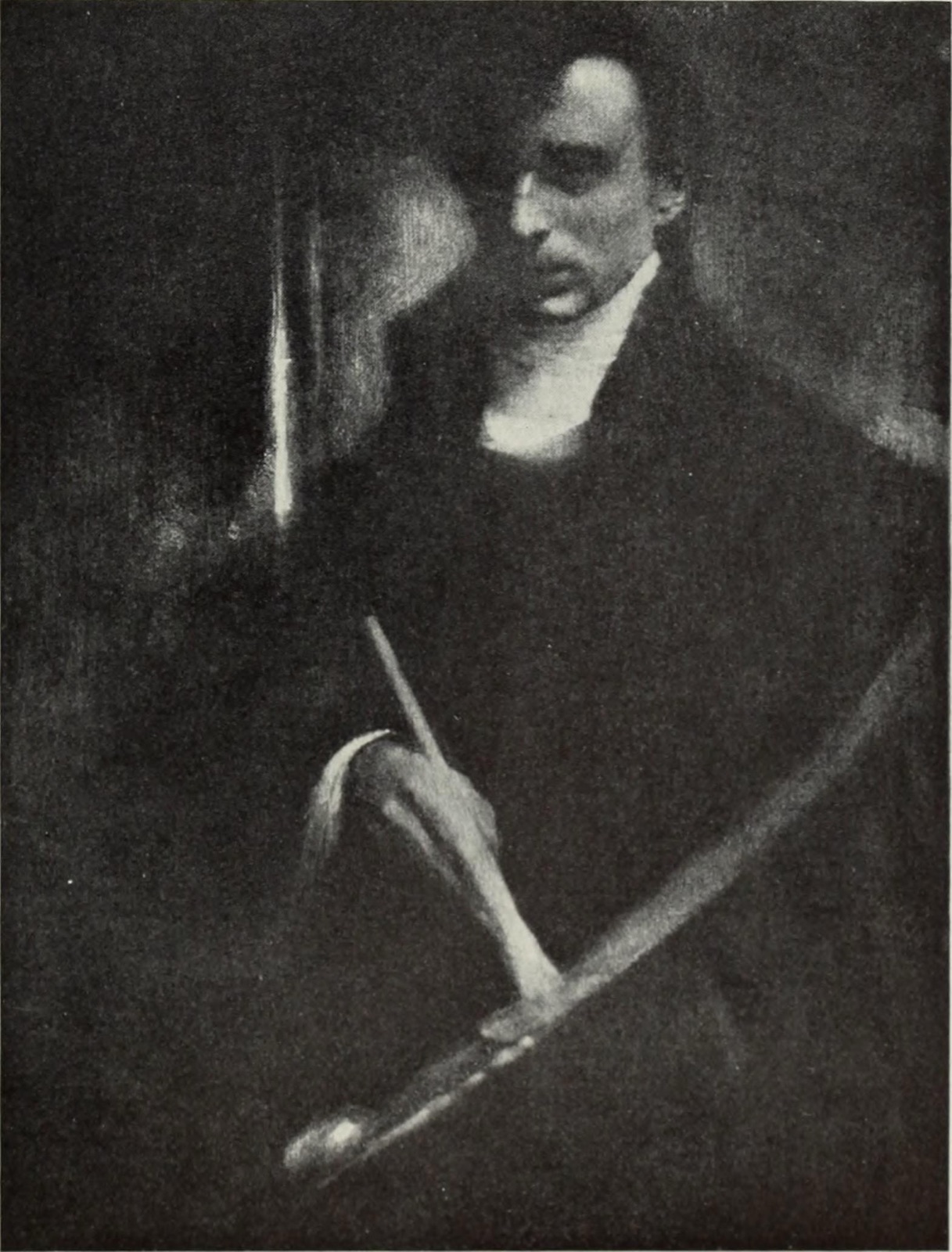
The 1901 self-portrait at the top of this page appears in International Studio magazine in 1908; by then Steichen was already a defining figure in the Photo-Secession movement, the Stieglitz-led circle that argued photography deserved to stand alongside painting as fine art.
The Morgan portrait
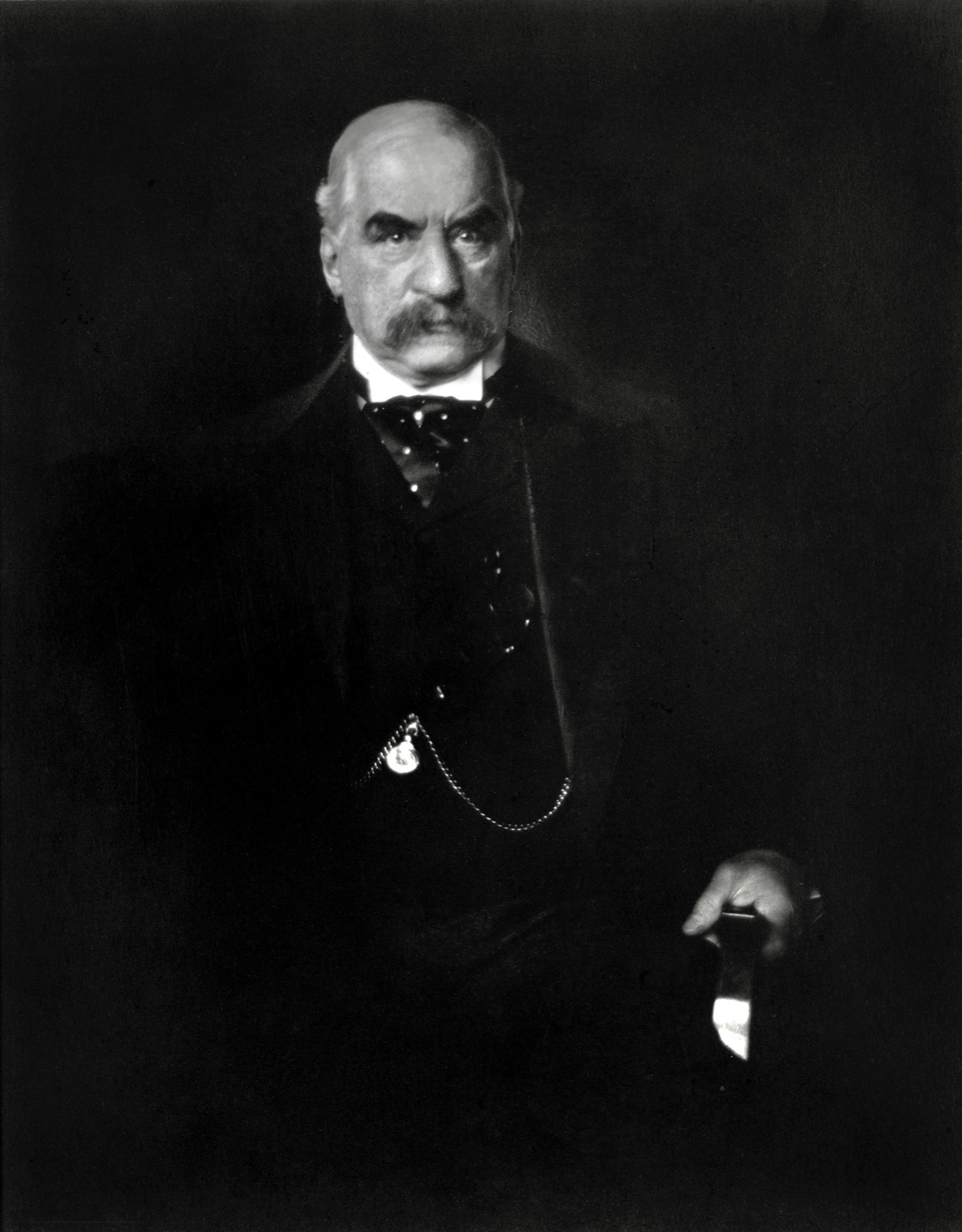
In 1903 Steichen photographed J. Pierpont Morgan. The financier had agreed to only a few minutes. The light catching Morgan’s hand on the chair-arm reads, in this widely-circulated frame, as a blade — an optical accident that art-history literature has discussed since. The portrait remains one of the defining American photographs of the early twentieth century.
.jpg)
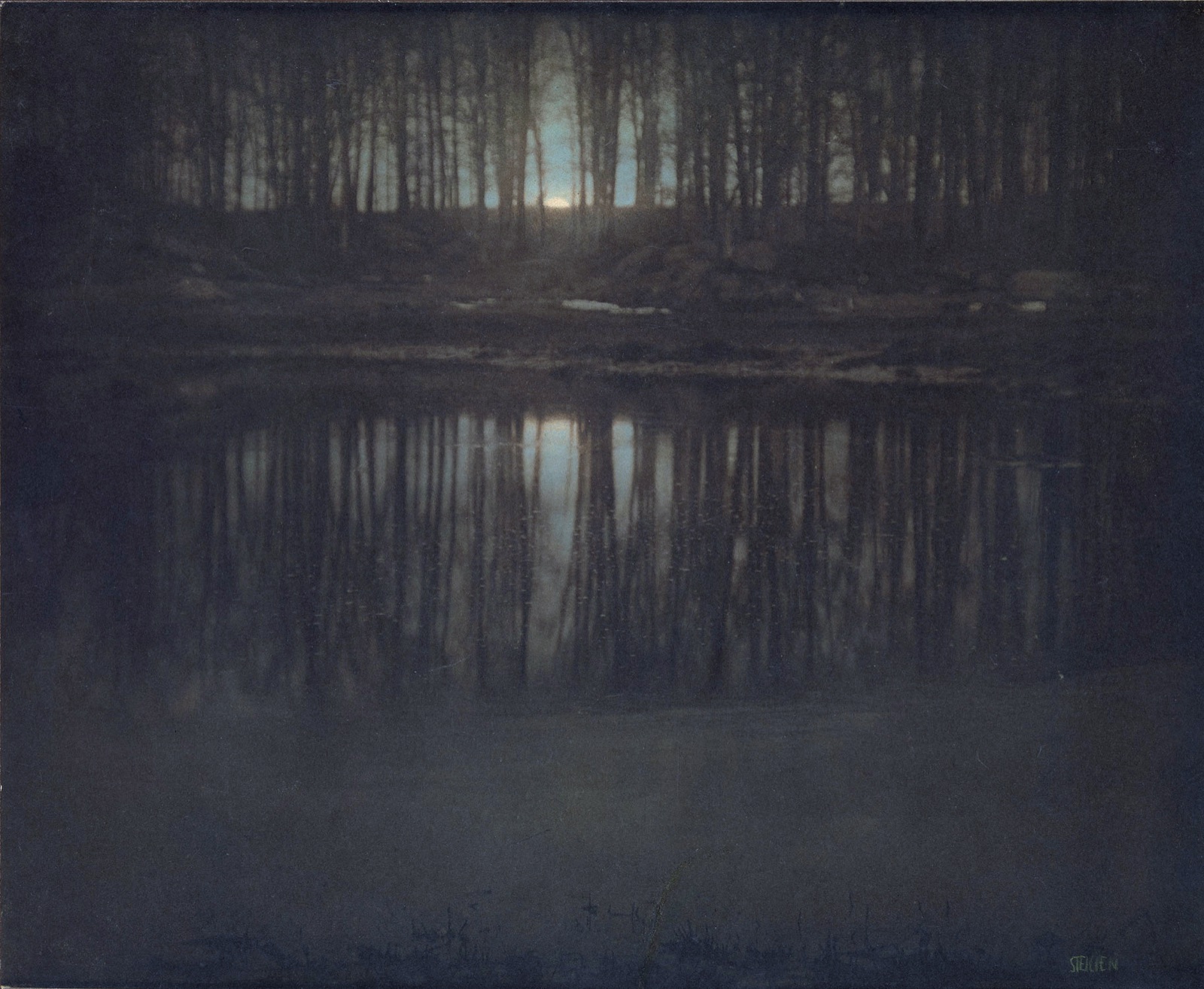
A Pictorialist masterwork — The Pond — Moonlight (1904)
In 1904, in Mamaroneck, New York, near the home of the art critic Charles Caffin, Steichen made one of the defining photographs of his early Pictorialist period. The print is a gum-bichromate produced with hand-applied light-sensitive gums, yielding one-of-a-kind images; only three are known to survive — held by the Metropolitan Museum of Art and the Museum of Modern Art (New York).2

Stieglitz and the 291 Gallery
In 1905 Steichen and Stieglitz opened the Little Galleries of the Photo-Secession in what had been Steichen’s portrait studio. The space quickly became known by its address — the 291 Gallery.2
Carl Sandburg, brother-in-law
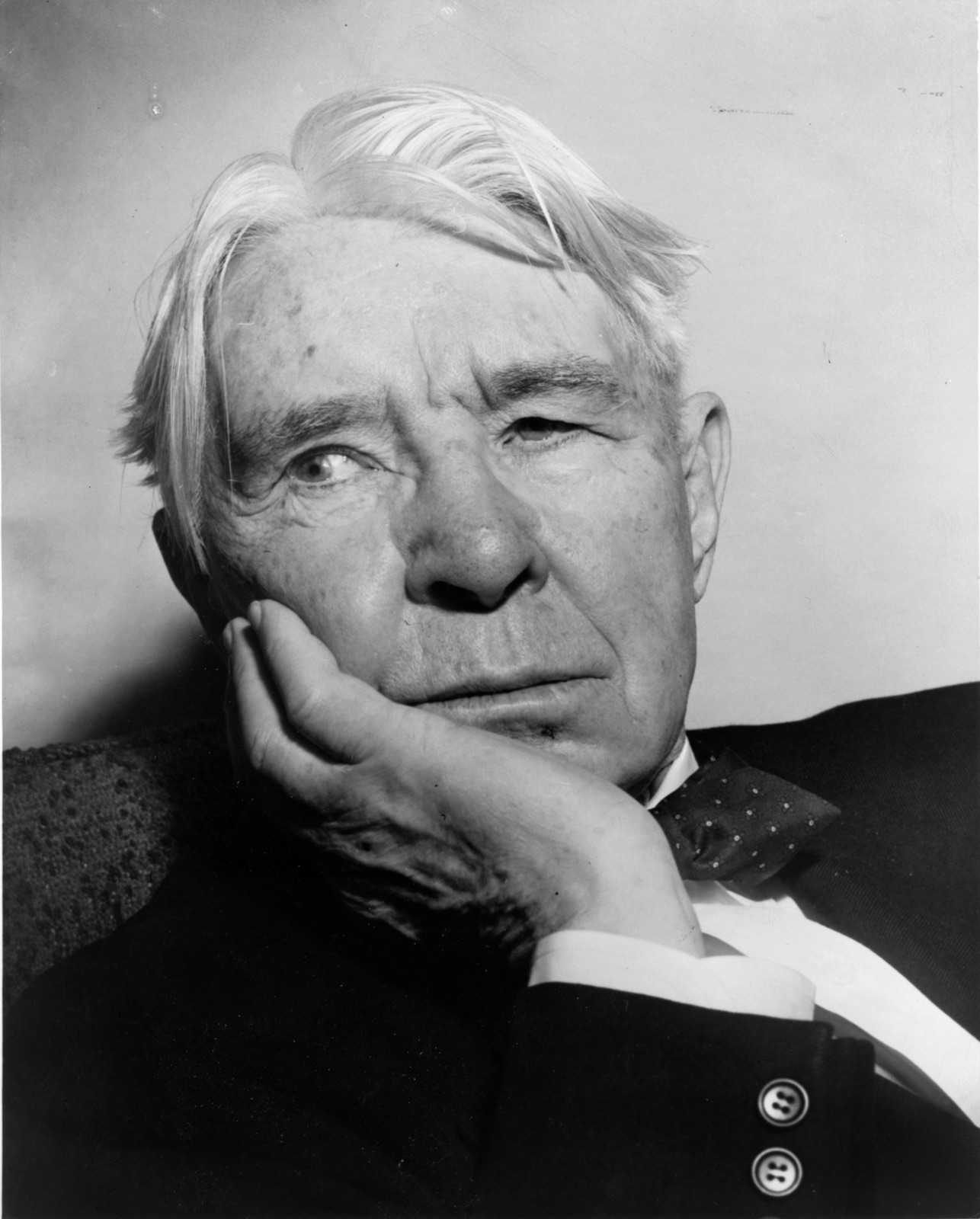
Steichen’s sister Lilian Steichen married the poet Carl Sandburg in 1908.3 The marriage made Steichen and Sandburg lifelong collaborators: Sandburg would write the prologue to The Family of Man almost half a century later. The title is widely attributed to a Sandburg poem; the precise primary attribution has not been re-fetched in this round and is flagged accordingly in 2.

The First World War
Steichen returned to uniform in the First World War. He commanded the photographic division of the American Expeditionary Forces and came out of the war an Army Colonel.2 He would return to military service a quarter-century later, this time in the U.S. Navy.
Aerial reconnaissance: the AEF Photographic Section
The two-sentence summary above understates a more substantial story in the secondary literature on military aerial photography. He entered active duty in July 1917 as a first lieutenant; by the November 1918 armistice he had been promoted to major, and stayed in France into 1919 to direct documentation of the battlefields. His unit grew, by figures circulating in WebSearch summaries pointing at the Art Institute of Chicago’s Steichen archive (page returned 403 in our research round), to about 55 officers and 1,111 enlisted soldiers — pointer-only, not yet anchored to a Tier-1/2 military-history source.4
What the unit did, day by day, was image-intelligence: train air crews, fly camera-equipped aircraft over the Western Front, develop the negatives in field darkrooms, and put the prints in front of AEF commanders. Reports of daily output reached as many as 4,000 black-and-white prints per day — again pointer-only via WebSearch summaries, not anchored.4 The pipeline Steichen and his officers worked out — glass plate to overnight darkroom to next-morning briefing room — is described as a significant early episode of American aerial intelligence; the photographs themselves are recorded as held in an Art Institute of Chicago archive, in an album Steichen assembled himself in 1919, but the AIC pages were not directly reachable in our research round.4
Brancusi, the studio, and the 1928 customs case
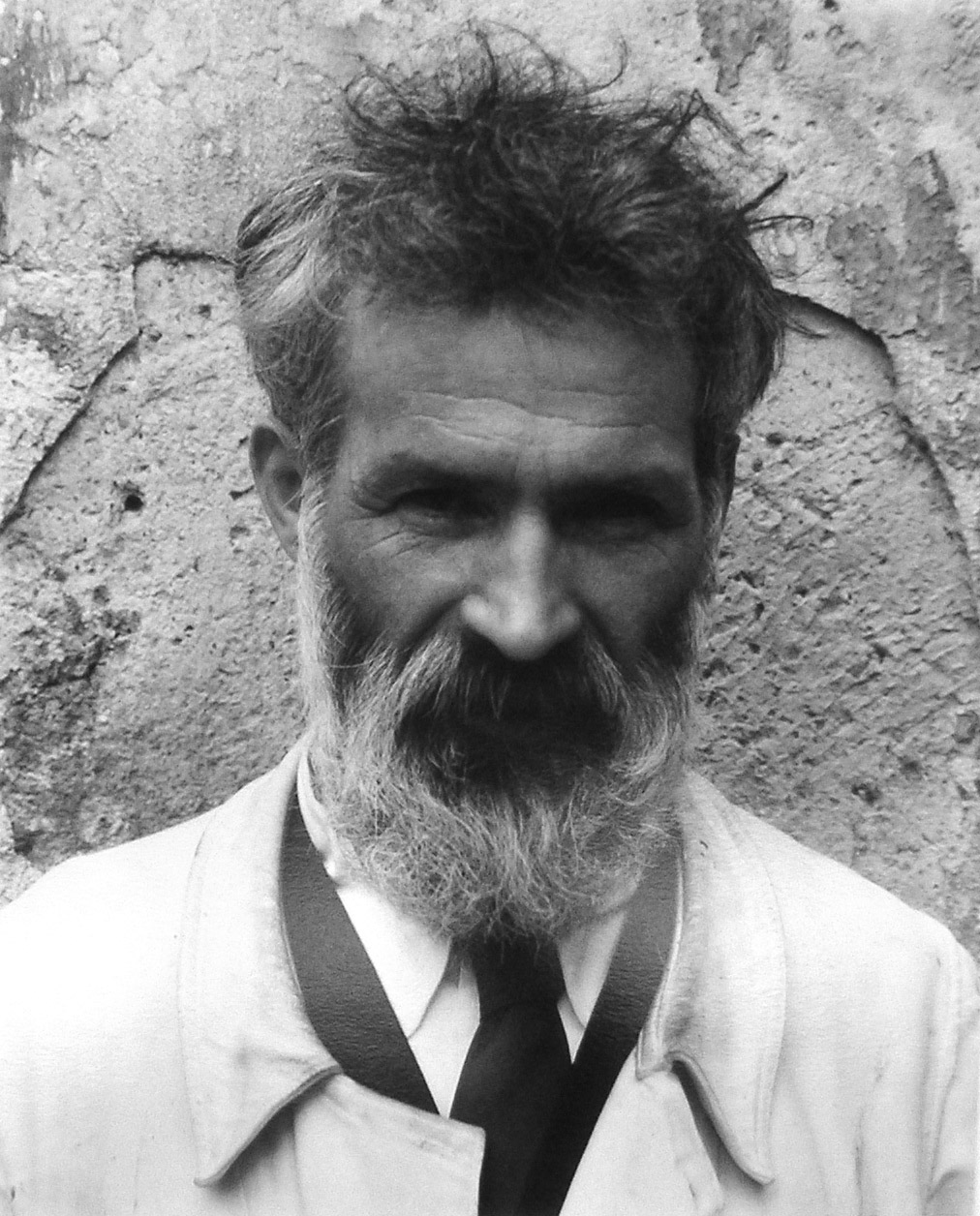

Among the friendships Steichen kept across the Atlantic in the interwar years, the closest with another artist was probably with the Romanian sculptor Constantin Brancusi. The two were near contemporaries — Brancusi was born in 1876 and died in 1957 (both dates per Wikipedia “Constantin Brâncuși”, fetched 2026-04-30, pointer-only); Steichen 1879–1973. Both were immigrants to a country other than their birth — Brancusi to France, Steichen to the United States — and both are remembered today as founding figures of, respectively, modern sculpture and modern photography.5
Steichen made a series of photographs of Brancusi and his Paris studio across the 1920s. The most-published of these, the 1925 portrait Brancusi in His Studio, Paris, is the only one of these dates anchored at Tier 2 in this wiki at the time of writing — see 5. The Wikipedia article on Brancusi (fetched 2026-04-30) credits earlier Steichen photographs of the same studio dated 1920 and a portrait of Brancusi dated 1922; a 1927 print is recorded by MoMA as Constantin Brancusi in his Studio (collection 48872), and the Metropolitan Museum holds Brancusi’s “Endless Column” in Mr. Steichen’s Garden, Voulangis, France, which records that Brancusi’s Endless Column was installed at Steichen’s house in Voulangis in the French countryside. Those museum catalog records were attempted in this round but returned HTTP 403/429; the dates and titles in this paragraph are pointer-only until those records are re-fetched.6
In October 1926 a Bird in Space — one version of Brancusi’s polished bronze series — arrived in New York harbor on the steamship Paris, alongside nineteen other Brancusi sculptures destined for U.S. exhibition. U.S. Customs officials refused to classify the polished bronze as art. Under the 1922 Tariff Act, an “original work of a professional sculptor” was duty-free; what officials saw on the dock was, they said, a “manufactured metal object,” subject to a 40% tariff (~US$230 on the declared value).6
Steichen — recorded in some accounts as the buyer of this Bird in Space, in others as the consignee who would take possession after the New York exhibition — filed an appeal of the customs decision in November 1926. The case became Brancusi v. United States. In November 1928, Judges Young and Waite of the U.S. Customs Court ruled in favor of the artist. Justice Waite’s opinion noted a “so-called new school of art, whose exponents attempt to portray abstract ideas rather than imitate natural objects” — a sentence quoted in essentially every secondary account of the case.6
Whether Steichen personally took the witness stand at the 1928 trial — as some Wikipedia summaries imply alongside Jacob Epstein and other witnesses — or whether his name appears only as the consignee/appellant on the case caption is not resolved by the pointer sources used here; the Bellevue College reproduction of the court-extract material shows Epstein’s deposition and Justice Waite’s judgment but does not show Steichen’s testimony. This question, and the precise nature of Steichen’s purchase or commission of the sculpture, must be re-checked against the official court reporter (the U.S. Customs Court 1928 decision, conventional reporter citation form to be re-verified before use), Niven 1997 (src-niven-1997), or Steichen’s own 1963 autobiography (src-steichen-1963-life) before being treated as Tier 1.6
The Brancusi v. United States ruling is one of the most-cited U.S. legal recognitions of abstract sculpture as art in the early 20th-century art-history literature. Steichen’s role — importer, appellant, and photographer of the artist — is one of the more concrete documentary links between his interwar Paris connections and the curatorial work he later did at the MoMA Department of Photography from 1947 onward.
Perspective note. This section follows the standard secondary-literature framing of Brancusi v. United States as a recognition of abstract sculpture as art, with Steichen as importer and appellant. Other readings exist in the wider scholarship: Marcel Duchamp’s role in organising the U.S. shipment and placing Brancusi’s work with American collectors is treated by some art historians as more central to the New York side of the affair than Steichen’s; later scholarship has also read the case in terms of art-market consolidation and the institutional canonisation of male modernist sculpture, not only as aesthetic vindication. Those readings are not anchored to in-repo Tier-1/2 sources in this round and should be added when consulted.
Vogue, the Navy, and MoMA
From 1923 to 1938 Steichen served as chief photographer for the Condé Nast magazines Vogue and Vanity Fair, a body of work that established the modern grammar of fashion and celebrity portraiture and made him, by some accounts, the highest-paid photographer alive.2
The delphiniums (June 1936)
In June 1936 the Museum of Modern Art devoted its galleries — for one week — not to a painter, not to a sculptor, not even to a photographer, but to a flower. Edward Steichen’s Delphiniums ran roughly 24 June – 1 July 1936, by accounts surfaced in this round; it was the first MoMA exhibition dedicated to a single living plant, and remains, by those same accounts, the only flower show in the museum’s history. Steichen had spent decades cross-breeding delphiniums on his property in Connecticut; he trucked the spikes to Manhattan himself.7
The hobby was not casual. Per the same WebSearch sources (returned 403 to our direct fetches and not anchored against a Tier-1/2 monograph), Steichen is reported to have served as president of the American Delphinium Society from 1935 to 1939, and the techniques he was deploying on his Connecticut acreage are reported to have included colchicine — a chemical mutagen that induces chromosome doubling — applied directly to the plants. Some recent art-history readings place the 1936 delphiniums at an origin point of what is now called the bio-art tradition; that lineage attribution is editorial framing carried from secondary writing, not anchored here.7
The episode rounds out the picture of Steichen as a working artist between his Vogue years and his MoMA directorship: a Connecticut grower whose hobby crossed into chromosome-doubling chemistry, a one-week solo flower show at MoMA, and a horticultural-society role.
The Naval Aviation Photographic Unit
The Second World War interrupted Steichen’s Vogue trajectory. Steichen returned to the U.S. Navy and led the Naval Aviation Photographic Unit, an outfit of “six officer-photographers”8 tasked with documenting carrier aviation in the Pacific. The Wikimedia photograph below records him on the USS Lexington in November 1943, captioned by the National Archives as “Cmdr Edward Steichen.”
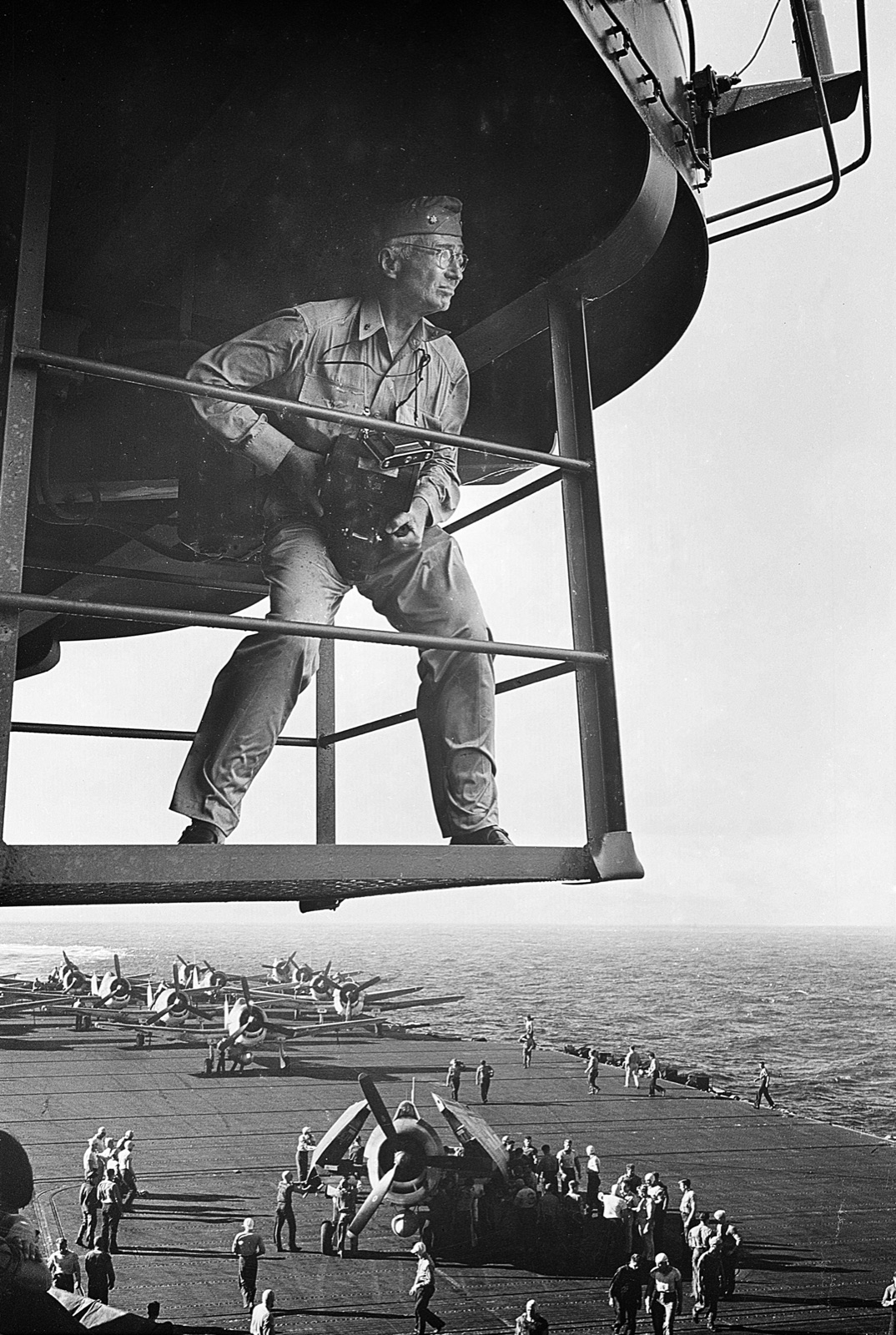

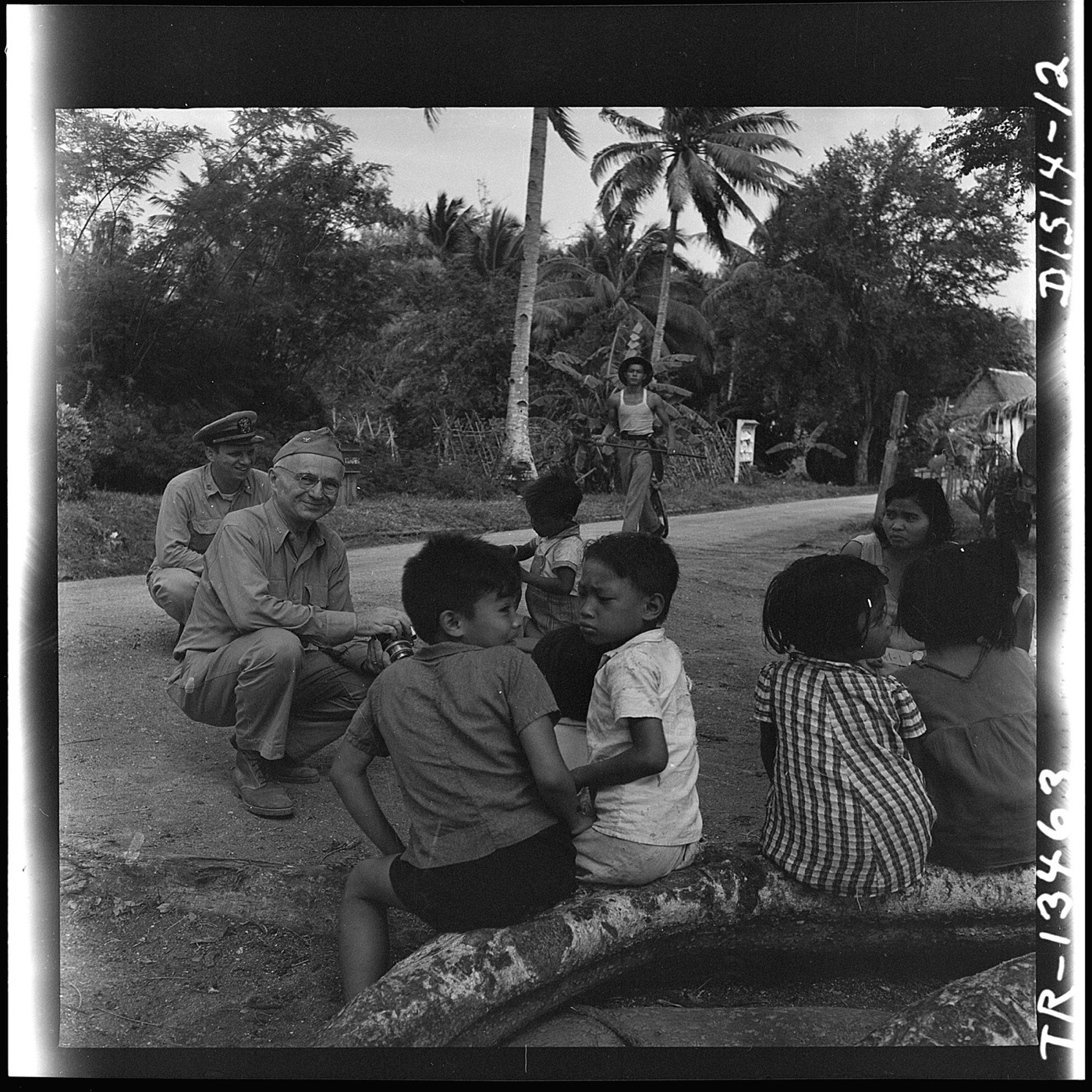
The unit was formed in early 1942 under Captain Arthur W. Radford and demobilised after August 1945. Steichen recruited the original photographers personally: Wayne Miller, Dwight Long, Charles E. Kerlee, Charles Fenno Jacobs, Horace Bristol, Victor Jorgensen, and Alfonso Iannelli. Ansel Adams declined.9 Wikipedia’s article on the unit (fetched 2026-04-30) summarises Steichen’s editorial concern verbatim as: “It was Steichen’s prime concern—don’t photograph the war; photograph the man, the little guy; the struggle, the heartaches, plus the dreams of this guy. Photograph the sailor.” The framing is the Wikipedia narrator’s, not a direct Steichen quote; the same article anchors a second, separately attributed quote to Wayne Miller about Steichen’s instruction to him personally — both are pointer-only via Wikipedia.9
The unit produced two books and one major MoMA exhibition. Power in the Pacific opened at MoMA in early 1945 and was accompanied by a Steichen-edited book of the same title. The Blue Ghost (1947) documented Steichen’s November 1943 tour aboard USS Lexington — the same tour that produced the photograph above. A retrospective volume, Steichen at War, gathered the unit’s output in 1981. The Smithsonian National Air and Space Museum holds the Edward J. Steichen World War II Navy Photographs Collection as a primary archive of this body of work.9
The 1947 appointment: displacing Beaumont Newhall
Steichen’s arrival at MoMA as Director of the Department of Photography in 1947 was not a tidy succession. The department’s founding curator was Beaumont Newhall, who had built it from 1940 and run it through the war (his wife Nancy Newhall acted as curator while Beaumont himself served in army photo-intelligence). The 1947 reorganisation made Steichen director and demoted Newhall to curator. Per the Wikipedia article on Newhall (fetched 2026-04-30, pointer-only): “He resigned from MoMA in 1947 after discovering that Edward Steichen was to direct the photography department, while Newhall was to remain as curator.”10
In the secondary literature, the split is read as a difference of curatorial philosophy — Newhall and the Newhall–Adams circle in a modernist-formalist register, Steichen coming off the wartime crowd-success exhibitions Road to Victory (1942) and Power in the Pacific (1945) into a documentary-editorial register oriented toward broad public reception. That philosophical framing is the standard reading of the 1947 transition in writing on photographic-history institutions; in this wiki it is carried at the Wikipedia-pointer level only, since the canonical scholarly source — Christopher Phillips, “The Judgment Seat of Photography,” October 22 (1982) — is in the bibliography but its body text was not consulted in our research (JSTOR returned 403). The 1947 transition gave Steichen the directorship, the budget, and the editorial scale that The Family of Man would later require.
Newhall, for his part, went to the George Eastman Museum in Rochester in 1948 — first as curator (1948–1958), then as director (1958–1971) — building the alternative tradition of photographic art-history writing that The Family of Man would, in the 1960s and 1970s, be partly read against (Phillips, October 22, 1982 — see the Reception page).
Perspective note. This section describes the 1947 curatorial succession descriptively and on Wikipedia-pointer evidence. For the canonical critical reading — that the institutional consolidation Steichen achieved at MoMA enabled an aestheticised, depoliticised humanism, the very target of the Family of Man critical tradition — see Phillips, “The Judgment Seat of Photography,” October 22 (1982), and Sekula 1981/1986 (
src-phillips-1982-judgment-seat,src-sekula-1981,src-sekula-1986, all in repo, allverified: falseuntil JSTOR/body-text fetches succeed). The “broad public” framing above is one reading; it is also the framing those critics indict.
In 1947 he was named Director of the Department of Photography at the Museum of Modern Art, a post he held until 1962. The CNA’s biographical portrait of him for this period puts the curatorial pivot bluntly:
“When he was named the director of the Photography Department at the Museum of Modern Art in New York from 1947 to 1962, Steichen’s photographer career became secondary and he dedicated his time to make other artists famous.”1
Documented MoMA exhibitions Steichen organised before and during his directorship — and that secondary literature treats as precursors to The Family of Man — include Power in the Pacific: Battle Photographs of our Navy in Action on the Sea and In the Sky (1945, while he was still in uniform), Korea — The Impact of War in Photographs (1951), Five French Photographers (1951–52), and Postwar European Photography (1953).2
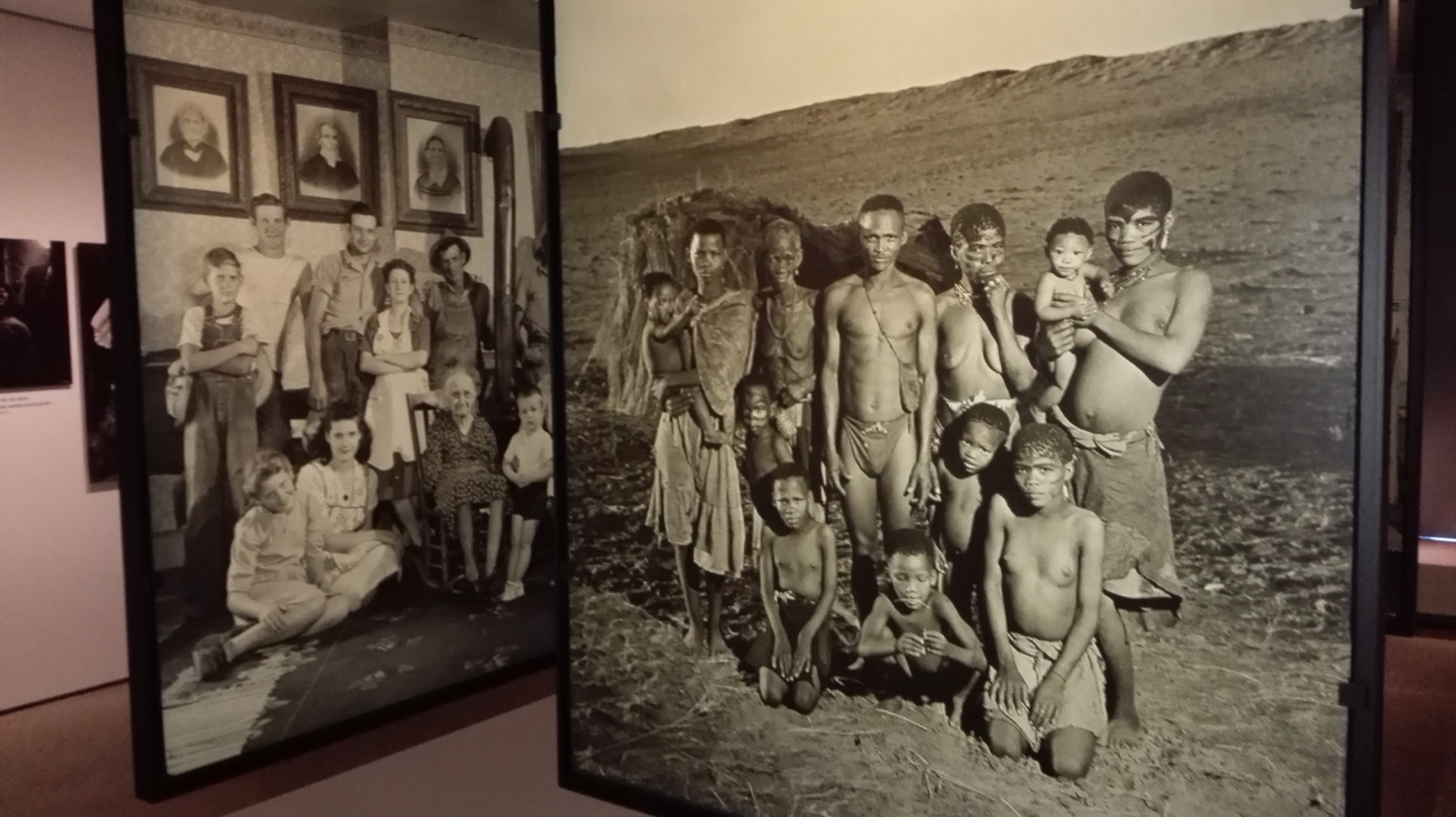
The Family of Man opened on 24 January 1955.
The Family of Man
The Family of Man opened at MoMA on 24 January 1955 and toured the world until 1965 — an arc the CNA describes as “the consecration of his most ambitious project: to explore the potential of photography as a means of communication and prove its capacity to interact with the world as much as it was showing it.”1
The exhibition’s prologue was written by Carl Sandburg — Steichen’s brother-in-law (Sandburg married Steichen’s sister Lilian in 1908). Its installation was designed by the architect Paul Rudolph, then at the start of his career; he would later chair Yale University’s Department of Architecture from 1958 to 1965 — see the Exhibition page for that citation.
For the exhibition’s catalog and structure see the Photographs index, the Sections, and the Sources.
The 1963 meeting and the gift to Luxembourg
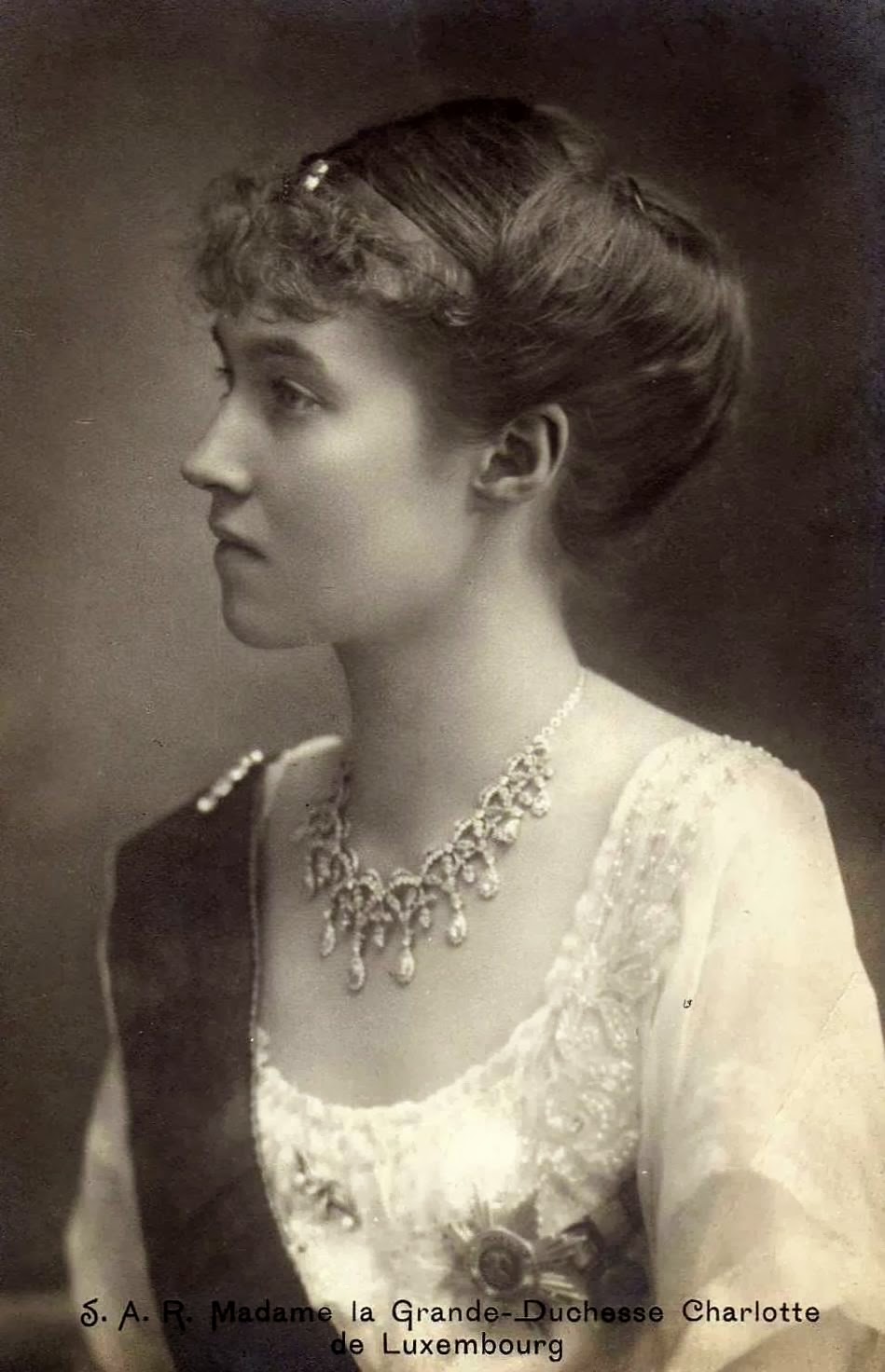
In 1963, during the Grand Duchess of Luxembourg’s state visit to Washington, Steichen met Grand Duchess Charlotte at the White House. He introduced himself with the line that has since become the keystone of the Luxembourg-Steichen story:
“the Luxembourg-born photographer met Grand Duchess Charlotte during a state visit to Washington in 1963, where he introduced himself by stating: ‘I am a Luxembourgish boy.’”11
The encounter triggered the diplomatic sequence that returned the exhibition to his birthplace:
“at his request, led to the US government’s donation of The Family of Man exhibition to Luxembourg in 1964.”11
In 1966 he visited the prints’ eventual home at Clervaux Castle, where he is reported to have said the castle was “the ideal place for the exhibition to reside.”11
The Bitter Years (1962)
Steichen’s last exhibition as MoMA Director of Photography opened in 1962. The Bitter Years showed photographs by Walker Evans, Dorothea Lange, Arthur Rothstein, Jack Delano, Ben Shahn, Russell Lee and other photographers who had worked for the Farm Security Administration (FSA) under Roy Stryker between 1935 and 1944 — the visual record of Depression-era rural America. Per the CNA’s Steichen Collections page (fetched 2026-04-30), Steichen had encountered the FSA archive in 1938 and called the photographs “the most remarkable human documents ever rendered in images.”12
The exhibition was also the second of Steichen’s two great curatorial gifts to Luxembourg. After its 1962–1967 tour through the United States and Europe, the collection was, per the CNA’s record, bequeathed by MoMA to the Grand Duchy of Luxembourg in 1967, “following the wish of Edward Steichen.” It was housed at the Musée National d’Histoire et d’Art from 1968, transferred into the Centre national de l’audiovisuel archives in 1989, and from September 2012 displayed in a permanent installation in Dudelange’s Waassertuerm (water tower) — a converted industrial water tank, reported in WebSearch summaries as dating to 1929 (the construction date and architect attribution are pointer-only and not in the CNA fetch). The installation closed to the public in December 2020 and the collection returned to the CNA archives.12
Both collections came to Luxembourg following Steichen’s own wishes — The Family of Man via the 1964–66 negotiations and his 1966 Clervaux visit (where he is reported to have called the castle “the ideal place for the exhibition to reside”); The Bitter Years via the 1967 MoMA bequest “following the wish of Edward Steichen.” The choice of buildings — Clervaux Castle and the Dudelange Waassertuerm — was made by the Luxembourg state and the CNA. Clervaux’s selection is associated with Steichen’s own 1966 visit; the Dudelange water tower’s selection happened in the years before the 2012 opening, decades after Steichen’s 1973 death. Today both installations are operated by the CNA, and together they bracket the Luxembourg-Steichen story — colour-and-celebration humanism in the Ösling north, black-and-white Depression-era documentary in the Minett south.

Critical readings
The institutional voice that anchors this page — the CNA’s biographical portrait — is curatorial. Steichen’s exhibition has been read very differently by other voices.
Roland Barthes (1957) opens the modern critique in Mythologies. He argues that the show’s universalism — birth, death, work, love presented as shared human constants — flattens history and politics. By staging the universal as natural, the exhibition (Barthes writes) precludes the specific question that any honest political photograph should provoke: whose mortality, whose labour, whose family, under what conditions.13
Eric Sandeen (Picturing an Exhibition: The Family of Man and 1950s America, University of New Mexico Press, 1995) is the standard book-length historical study. Sandeen complicates both Steichen’s framing and Barthes’ counter-framing with archive evidence from the 1955 MoMA opening and the USIA tour: he reconstructs how the show was assembled, how it was received venue by venue, and how its Cold War sponsorship shaped what was shown and what wasn’t.14
These two readings — and the later voices of Susan Sontag (1977), Allan Sekula (1981), Blake Stimson (2006), and Fred Turner (2013) — are the conversation Steichen’s most-visited exhibition has provoked for nearly seven decades. See the Reception page for the full critical thread; the works above are recorded in the Bibliography.
Last years
Steichen had married Joanna Taub in 1960 — by Wikipedia’s account his third marriage, after Clara Smith (1903–1922) and Dana Desboro Glover (1923–1957). The CNA records Joanna as “fifty-four years his junior.”12 He died at his home in West Redding, Connecticut, on 25 March 1973, two days before his 94th birthday.2 Joanna Steichen survived him by thirty-seven years (2010 − 1973); she died in Montauk, New York, on 24 July 2010.2
What the collection became
The collection he assembled returned permanently to Clervaux Castle in 1994,15 twenty-one years after his death. It was inscribed on UNESCO’s Memory of the World register in 2003,16 recognising it as documentary heritage of universal significance, and was rebuilt under a major restoration program in 2010–2013.15
.jpg)
The institutional custodian of the collection today is the Centre national de l’audiovisuel — see the Clervaux page for the present-day curation.
verified: false until they are. The CNA's institutional biography is the Tier-1 anchor used here.
-
Centre national de l’audiovisuel (CNA), Luxembourg. Edward Steichen: From a Man of His Time to an Artist Out of Time. Educational portal —
src-cna-edu-steichen-bio. Anchors: birth in Bivange 1879; emigration “barely 2 years old”; MoMA Director 1947–1962; The Family of Man opens 1955 and tours to 1965; “in 1960 he remarried Joanna Taub – 54 years his junior.” ↩ ↩2 ↩3 ↩4 ↩5 -
Biographical commonplaces grouped here are widely repeated in standard biographical references, including the Wikipedia entry for Steichen (fetched 2026-04-25) and the Niven 1997 monograph Steichen: A Biography. The cluster covers: first camera 1895; Stieglitz attention by 1900; naturalization 1900; the 1905 Little Galleries of the Photo-Secession / 291 Gallery with Stieglitz; Condé Nast chief photographer 1923–1938; the optical-effect framing of the 1903 Morgan portrait; First World War command of the photographic division of the American Expeditionary Forces and Army Colonel rank; the pre-FoM MoMA exhibitions Power in the Pacific (1945), Korea — The Impact of War in Photographs (1951), Five French Photographers (1951–52), and Postwar European Photography (1953); Steichen’s three marriages — Clara Smith (1903–1922), Dana Desboro Glover (1923–1957, who pre-deceased him), and Joanna Taub (1960–1973); and the death of Joanna Taub Steichen in Montauk, New York, on 24 July 2010 (aged 77). The cluster also covers The Pond — Moonlight (1904, Mamaroneck NY, near the home of Charles Caffin; gum-bichromate with hand-applied gums; three known surviving prints held by the Metropolitan Museum of Art and MoMA; a print sold at Sotheby’s in February 2006 for “US$2.9 million” per the Wikipedia source) — these specific facts are attested by the Wikipedia article The Pond—Moonlight and the corresponding Wikimedia Commons file page (both fetched 2026-04-26). None of those primary biographical sources were fetched in this round; the bundle should be treated as
verified: falseuntil Niven 1997 (or an equivalent primary biographical source) is consulted directly. The same disclaimer covers the Sandburg-poem-as-title-source claim, which is recorded with primary citation inresearch/sections.md(citingsrc-moma-1955-press-release-bookandsrc-moma-1955-catalog) but those primary sources were not re-fetched in this session. ↩ ↩2 ↩3 ↩4 ↩5 ↩6 ↩7 ↩8 ↩9 ↩10 ↩11 -
Wikipedia, Carl Sandburg (fetched 2026-04-25): “In 1907, Sandburg met Lilian Steichen (1883–1977), sister of photographer Edward Steichen, at the Milwaukee Social Democratic Party office. They married the following year [1908] and had three daughters.” Per
CREDIBILITY.md, Wikipedia is pointer-only; the canonical primary source for this would be the Sandburg-Niven correspondence or Niven’s biography, neither re-fetched here. Carried as a tier-3-equivalent until upgraded. ↩ -
Steichen’s WWI command of the AEF Photographic Section: framing surfaced in WebSearch results 2026-05-01 attributing the “55 officers and 1,111 enlisted soldiers” and “as many as 4,000 black-and-white prints per day” figures to the Art Institute of Chicago’s Steichen archive (
archive.artic.edu/steichen/). The AIC archive was attempted via WebFetch this round and returned HTTP 403; the figures and the 1919 album holding (83 gelatin silver prints assembled by Steichen himself) are pointer-only until the AIC pages can be opened directly or a Tier-1 military-history source consulted. The July 1917 entry as first lieutenant and November 1918 promotion to major are widely repeated in standard biographical references (Wikipedia Edward Steichen and the secondary literature on military aerial photography); not independently re-verified against a Tier-1/2 source this round. ↩ ↩2 ↩3 -
Aperture Foundation, Edward Steichen: Brancusi in his studio, Paris, 1925 —
src-aperture-prints-brancusi-1925. Anchors the title and the 1925 dating of one of Steichen’s photographs of Brancusi in his Paris studio. The framing of Brancusi as “one of the founding figures of modern sculpture” and Steichen as “one of the founding figures of photography” is institutional / promotional language reproduced verbatim from the Aperture page (fetched 2026-04-30). ↩ ↩2 -
Steichen-Brancusi material: this paragraph and the next two draw on three pointer sources, all fetched 2026-04-30: the Wikipedia article Constantin Brâncuși (“in 1926 … photographer Edward Steichen purchased it [a Bird in Space] and shipped it to the United States”; “Photograph by Edward Steichen, 1922”; “Brâncuši’s Paris studio, 1920, photograph by Edward Steichen”); the Wikipedia article Bird in Space (October 1926 arrival on the steamship Paris alongside 19 other Brancusi sculptures; 40% tariff; Steichen “filed an appeal to the U.S. Customs’ decision to reclaim the money”; November 1928 ruling by Judges Young and Waite; the operative line from Justice Waite’s opinion); and the Bellevue College reproduction of court-extract material (
bellevuecollege.edu/artshum/.../BrancusiCourtCase.htm), which contains Jacob Epstein’s deposition and Justice Waite’s judgment but does not show Steichen testifying. The Met Museum object records for Brancusi’s Studio (search/266850) and for Brancusi’s “Endless Column” in Mr. Steichen’s Garden, Voulangis, France (search/687837), and the MoMA collection record for Constantin Brancusi in his Studio. 1927 (collection 48872), are attested by a 2026-04-30 Google search ofmetmuseum.organdmoma.orgbut their canonical catalog pages returned HTTP 403/429 in this round and have not been read directly. The conventional reporter citation form for the 1928 U.S. Customs Court decision (commonly given in the secondary literature as “T.D. 43063, 54 Treas. Dec. 428”) has not been fetched or verified in this round and should be confirmed against an actual court reporter before being treated as authoritative — the upgrade path is inresearch/steichen-brancusi.md. PerCREDIBILITY.mdWikipedia is a pointer source, not an authority. ↩ ↩2 ↩3 ↩4 -
Edward Steichen’s Delphiniums at MoMA: the dates 24 June – 1 July 1936, the “first and only dedicated flower show” framing, the Delphinium Society presidency 1935–1939, and the colchicine-mutagen technique were surfaced from WebSearch results 2026-05-01 attributing them to a
redmuseum.churchreconstruction page and a Hannah Stippl research-catalogue entry. Both pages were attempted via WebFetch this round and returned permission-denied / 403; the canonical MoMA exhibition page (moma.org/calendar/exhibitions/2940) also returned 403. The framing here should be treated as pointer-only until those pages can be opened directly. The bio-art lineage attribution is editorial framing carried from secondary sources, not from a Tier-1 art-history monograph fetched this round. ↩ ↩2 -
Wikipedia, Edward Steichen (fetched 2026-04-25): notes Steichen as one of “six officer-photographers” of the Naval Aviation Photographic Unit. Same Wikipedia caveat as
[^5]. ↩ -
Wikipedia, Naval Aviation Photographic Unit (fetched 2026-04-30) — anchors: formation early 1942, “Training Literature Field Unit No. 1,” demobilization after August 1945, Captain Arthur W. Radford as Steichen’s superior, the seven recruited photographers (Miller, Long, Kerlee, Jacobs, Bristol, Jorgensen, Iannelli), Ansel Adams declining, the “don’t photograph the war; photograph the man, the little guy; the struggle, the heartaches, plus the dreams” verbatim quotation, the books Power in the Pacific (1945, MoMA exhibition + Steichen-edited book), The Blue Ghost (1947), and Steichen at War (1981). The Smithsonian National Air and Space Museum collection identifier (NASM.XXXX.0553) for the Edward J. Steichen World War II Navy Photographs Collection was returned in WebSearch results but the NASM page itself was not fetched directly. Per
CREDIBILITY.mdWikipedia is pointer-only. ↩ ↩2 ↩3 -
Wikipedia, Beaumont Newhall (fetched 2026-04-30) — verbatim: “He resigned from MoMA in 1947 after discovering that Edward Steichen was to direct the photography department, while Newhall was to remain as curator.” The Newhall–Adams modernist circle, the Junior Advisory Committee mass resignation, and the philosophical-difference framing are cited in secondary art-history literature (the canonical academic study is Christopher Phillips, “The Judgment Seat of Photography,” October 22, Autumn 1982 —
src-phillips-1982-judgment-seat, in repo, JSTOR returned 403 in our research round). The full Phillips body text has not been read in this round; the framing here is carried from Wikipedia plus secondary-snippet pointers and should be promoted to Tier 2 against the Phillips essay on a future pass. ↩ -
JCA. Cercle Cité Lecture Celebrates Life of Edward Steichen. Chronicle.lu, 1 April 2025 —
src-chronicle-lu-2025-cercle-cite-steichen. The original speaker and primary archival sources for these three points (1963 meeting, 1964 donation, 1966 Clervaux visit) are not given in the press article; the underlying Cour-grand-ducale or CNA archival documentation should be consulted to upgrade these claims to Tier-1. ↩ ↩2 ↩3 -
Centre national de l’audiovisuel (CNA), Luxembourg. The Bitter Years — Steichen Collections page (
steichencollections-cna.lu/eng/collections/2_the-bitter-years, fetched 2026-04-30). Anchors verbatim: “Designed in 1962” as Steichen’s “last exhibition” at MoMA, the photographers list (Evans, Lange, Rothstein, Delano, Shahn, Lee), the 1962–1967 tour, the 1967 bequest “following the wish of Edward Steichen,” 1968 transfer to MNHA, 1989 incorporation into CNA, 28 September 2012 opening at the Dudelange Waassertuerm, December 2020 closure, and the “most remarkable human documents ever rendered in images” Steichen quotation (carried as quoted by the CNA page). The 209-image figure circulating in secondary listings was returned in WebSearch results but is not on the CNA page’s primary text; it is pointer-only here. Architectural details (1929 water tower, 56-metre height, Kaell Architecte, founding director Claudine Kaell, tinted-concrete-and-steel materials) come from WebSearch snippets attributing them to Jim Clemes Associates / Wallpaper / boshua and have not been verified against the architect’s own monograph. ↩ ↩2 -
Roland Barthes, “The Great Family of Man,” in Mythologies (1957) —
src-barthes-1957. The foundational critical reading: argues that the exhibition’s universalist humanism flattens history and politics. Barthes is the canonical counter-voice to the CNA’s institutional framing. ↩ -
Eric J. Sandeen, Picturing an Exhibition: The Family of Man and 1950s America (University of New Mexico Press, 1995) —
src-sandeen-1995. The standard book-length historical study of the show — complicates both Steichen’s universalist framing and Barthes’ critique with venue-by-venue evidence from the USIA tour archives. ↩ -
Centre national de l’audiovisuel (CNA), Luxembourg. Familio de homo (German collections page) —
src-cna-collections-deu-family-of-man. Verbatim attests the 1994 inauguration (“Präsentation der Sammlung als Dauerausstellung im Schloss von Clervaux”) and the 2010–2013 second restoration phase (“Eine zweite Restaurierungsphase wurde in den Jahren 2010-2013 unternommen”). Fetched 2026-04-25. ↩ ↩2 -
UNESCO Memory of the World International Register, The Family of Man —
src-unesco-mow-2003. Inscription 2003. ↩